
Huawei unveiled its tri-fold smartphone, the " Mate XT 2 Ultimate Design " (hereinafter referred to as the "Mate XT 2"), in China on Monday, September 7, 2026.
It is the successor to the “Mate XT Ultimate Design” (hereinafter referred to as the “Mate XT”), which was the world’s first of its kind when launched two years ago, and features a new hinge mechanism.
Performance has also been improved, making it arguably the world’s most powerful foldable smartphone.
A 6.5-inch screen usable even when closed

The Mate XT 2 transforms into a slim form by folding from its open state to the left and right.
When closed, the display measures 6.5 inches with a resolution of 2442 x 1140 pixels.
The aspect ratio is 19.3:9, which is not significantly different from that of a standard smartphone.
In other words, it feels natural to use even when closed.
It features an 8-megapixel front-facing camera.
Flagship-Class High-Performance Camera
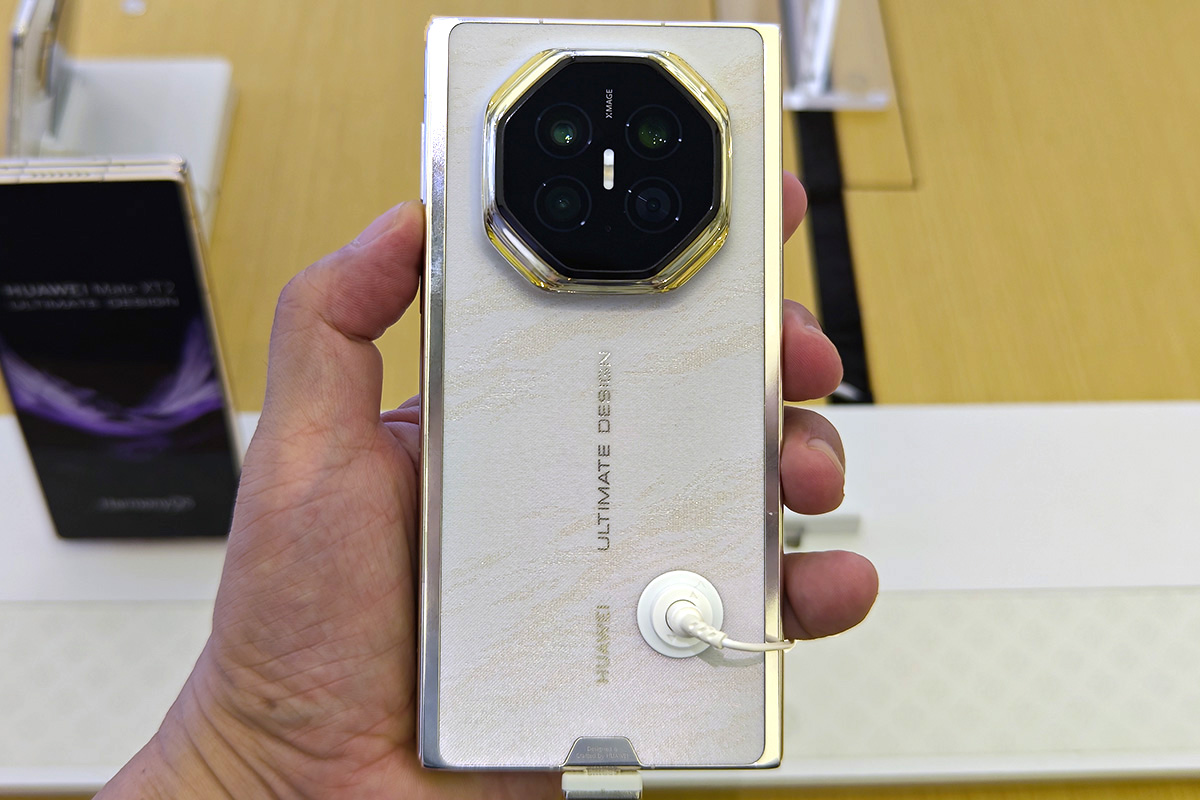
The rear features a 50-megapixel wide-angle camera, a 40-megapixel ultra-wide-angle camera, and a 50-megapixel 3.5x telephoto camera.
In terms of camera performance, it ranks among the best in the smartphone market—including competitors—and is more than capable of serving as a dedicated camera phone.
Furthermore, the wide-angle camera is equipped with a variable aperture.
It’s in the heavyweight class in terms of weight

When closed, the device measures 157.2 x 77.0 x 12.3 mm.
Given its design with three stacked displays, it’s quite thick.
It also weighs 299g, which feels quite heavy for a typical smartphone.
That said, it is lighter than Samsung’s “Galaxy Z TriFold”—another tri-fold smartphone with the same structure—which weighs 309g.

Looking down at the device when it’s closed, you can see that it’s designed to fold in from both sides.
It features a foldable display on the inside that can be folded into three sections, while another display is positioned on the outside that can be used even when the device is closed.
Can be used with just one screen open

Let’s try opening the device.
First, open the external display section to the left.
This results in a portrait-oriented display alongside the remaining closed portion, as shown in the photo.
Even in this state, you can use just the open screen.
Incidentally, on Samsung’s Galaxy Z TriFold, the screen appears blurry in this state and cannot be used.
The Mate XT 2 is a model with a G-type design that was released after Samsung’s, and it offers improved usability.
Physical anti-peeping mechanism

And when you open the remaining display to a 90-degree angle, it takes on a shape consisting of a square display screen plus a barrier.
This square display has the same shape as a typical bi-fold foldable smartphone.
By erecting the barrier next to it, you can prevent people from peeking in from the side.
Note that the same effect can be achieved by erecting the display on the opposite side.
Opening the Display with a G-Type Structure

As explained earlier, the Mate XT 2’s display allows you to use a large screen by opening it to the left and right.
Based on how the screens align when closed, this folding structure is commonly referred to as a “U-type” or “G-type.”
Samsung’s Galaxy Z TriFold has the opposite folding direction but features a similar structure.
The structure of the previous Z-type model

For reference, this is the previous model, the Huawei Mate XT.
It featured a Z-shaped design that folded like an accordion.
With the Z-shape, part of the main display remains visible on the outside even when folded, so there’s no need to include a separate display on the back like with the G-shape.
This helps keep costs and weight down.
On the other hand, as you can see in the photo, the display on the left hinge side remains exposed even when the device is folded.
Consequently, this part of the display is vulnerable to impact and prone to damage.
High-end model powered by the Kirin 9050 Pro

The Mate XT 2 features the “Kirin 9050 Pro” chipset, designed by HiSilicon, a subsidiary of Huawei.
The manufacturing process is believed to be 7nm-class, and it marks the first commercial application of “LogicFolding,” a proprietary technology that stacks circuits in two layers.
In terms of performance, the CPU is rated as comparable to Qualcomm’s Snapdragon 8 Gen 3, while its gaming performance is considered close to that of the Snapdragon 8 Elite.
Despite being unable to use cutting-edge manufacturing technology due to U.S. export restrictions, it has achieved a significant performance boost over the previous-generation Kirin 9030 Pro.

When unfolded, the display measures 10.2 inches with a resolution of 3184 x 2232 pixels.
The refresh rate is 90 Hz, which is slightly low for a modern smartphone.
Perhaps this is due to the foldable display.
This main screen also features an 8-megapixel front-facing camera.
It also supports handwriting input using an optional stylus.
A slim body, just 3.5 mm at its thinnest

When opened, the dimensions are 157.2 x 219.2 x 3.5 mm.
A thickness of less than 4 mm is truly remarkable.
Note that this thickness refers to the part without the display when the device is closed; the other sections of the three-part structure measure 3.69 mm and 4.0 mm, respectively.
Equipped with a privacy display

It also features a privacy display function, accessible through the display settings, which dims the screen so it’s not visible when viewed from the side.
This is a world first for a foldable smartphone.
Given the Mate XT 2’s large screen, the display is naturally more visible to those around you.
The privacy display function is particularly useful for a large screen like this.
I’d pay 600,000 yen to get my hands on it

The Mate XT 2 takes advantage of its large screen to display three apps simultaneously and even offers a “ foldable smartphone + standard smartphone ” style display combining a square and a portrait orientation.
The price for the 16GB RAM + 256GB storage model is 19,999 yuan (approximately 468,000 yen).
The top-of-the-line model with the privacy display—the 16GB + 1TB version—costs 24,999 yuan (approximately 585,000 yen), and adding a case and stylus brings the total over 600,000 yen.
Since it’s a multi-purpose device suitable for everything from business and entertainment to creative work with a stylus—and can be carried in your pocket on a daily basis—some people will likely find this price tag worthwhile.
▼Photo & Written by Yasuhiro Yamane/山根康宏
Blog: http://www.hkyamane.com/
X: https://x.com/hkyamane/
Note: https://note.com/hkyamane/


